
Instant kg to lbs Converter for Accurate Results

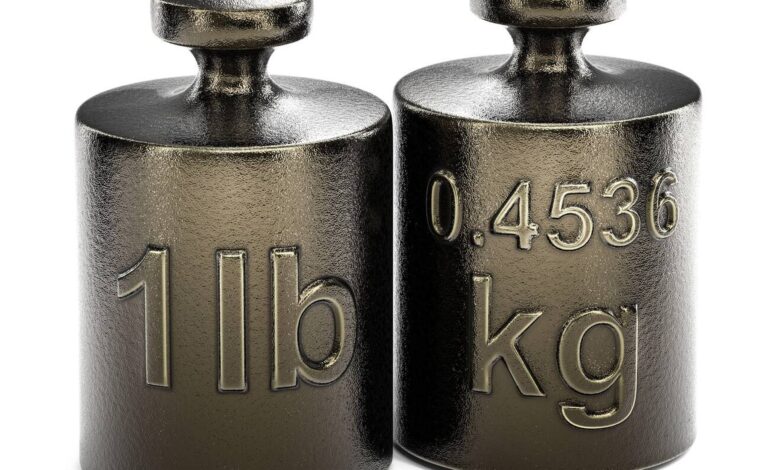
In today’s global environment, the ability to accurately convert measurements from kilograms (kg) to pounds (lbs) is more than a mere academic exercise; it’s a practical necessity for a myriad of professions and day-to-day activities.
From healthcare and fitness to international trade and travel, the kg to lbs conversion lays the foundation for clear communication and operational efficiency.
Understanding and applying this conversion accurately ensures that whether one is dealing with shipping weights, personal body weight, or food portions, the outcomes are precise and universally understood. This need has given rise to various tools and techniques, such as calculators and conversion tables, aimed at simplifying the process of converting kgs to lbs and vice versa.
Understanding the Basics of Weight Conversion
Definition of Kilograms (kg)
The kilogram, symbol kg, is the base unit of mass in the International System of Units (SI).
Defined in terms of the Planck constant as 6.62607015×10⁻³⁴ kg⋅m²⋅s−1, it is a crucial measure used globally in science, commerce, and daily life.
Originally, the kilogram was defined as the mass of one liter of water, but it has evolved to be determined by fundamental constants to ensure precision and universality.
Definition of Pounds (lbs)
The pound, symbol lb, is a unit of mass used in the imperial system, primarily in the United States and the United Kingdom.
It is legally defined as exactly 0.45359237 kilograms. The term “pound” is derived from the Roman unit libra, which influences its abbreviation ‘lb.’
This unit plays a significant role in various sectors including commerce and personal weight measurement.
Why Convert Between Kilograms and Pounds?
Conversion between kilograms and pounds is essential for international trade, science, and travel, ensuring clear communication and standardization across borders.
The need for accurate conversion is underscored by the differing measurement systems used around the world, with some countries preferring metric units (kg) and others using imperial units (lbs).
Conversion Table and Method
To convert kilograms to pounds, multiply the mass value by 2.20462. Here’s a comprehensive table for common conversions:
| Kilograms (kg) | Pounds (lbs) |
|---|---|
| 1 | 2.20462 |
| 10 | 22.0462 |
| 50 | 110.231 |
| 100 | 220.462 |
This table serves as a quick reference for converting between the two units, facilitating accurate and efficient calculations.
Step-by-Step Guide to Convert kg to lbs
Identifying the Conversion Factor
To convert kilograms to pounds, the key conversion factor is 2.2046. This means that 1 kilogram is approximately equal to 2.2046 pounds.
Understanding this factor is crucial for accurate conversions.
Calculating the Conversion: From kg to lbs
To calculate the conversion from kilograms to pounds, multiply the weight in kilograms by the conversion factor of 2.2046. For example, to convert 5 kilograms to pounds:
| Formula Component | Description |
|---|---|
| Mass in pounds (lbs) | ( 5 \text{ kg} \times 2.2046 \text{ lbs/kg} ) |
| Conversion Factor | ( 2.2046 \text{ lbs/kg} ) |
| Result | ( 11.023 \text{ lbs} ) |
Tools and Calculators to Simplify the Process
Utilizing online tools and calculators can simplify the conversion process from kg to lbs. These tools allow for quick and precise conversions, ensuring accuracy for tasks that require specific measurements in pounds.
| Kilograms (kg) | Pounds (lbs) |
|---|---|
| 1 | 2.205 |
| 10 | 22.05 |
| 50 | 110.25 |
| 100 | 220.5 |
This table provides a quick reference for converting kilograms to pounds using the standard conversion factor.
Practical Applications of kg to lbs Conversion
Converting Body Weight Measurements
In the United States, body weight is commonly measured in pounds, whereas kilograms are standard in many other countries.
For individuals tracking their weight for health or fitness, understanding how to convert these measurements is crucial. For example, a person weighing 75 kg can find their weight in pounds by multiplying by the conversion factor, resulting in approximately 165.35 lbs.
Using Conversion in Cooking and Baking
Recipes often require precise weight measurements. When using international recipes, cooks may need to convert ingredients from kilograms to pounds.
For instance, a recipe calling for 0.5 kg of flour would be about 1.1 lbs. This knowledge is essential for accurate ingredient adjustments and successful culinary outcomes.
Applying Conversion in the Field of Science and Engineering
In global industries like science and engineering, the kg to lbs conversion is vital for maintaining accuracy in measurements and specifications.
Engineers and scientists frequently convert these units to ensure consistency in project specifications, research documentation, and product development across different countries.
| Kilograms (kg) | Pounds (lbs) |
|---|---|
| 1 | 2.205 |
| 5 | 11.025 |
| 10 | 22.05 |
| 50 | 110.25 |
| 100 | 220.5 |
This table provides a quick reference for converting kilograms to pounds, facilitating accurate and efficient calculations across various practical applications.
Tips for Accurate Weight Conversion
Double-checking Your Calculations
Accuracy in weight conversion is paramount, as even a slight error can lead to significant discrepancies. Always verify calculations by using reliable tools or recalculating manually.
For instance, if converting 70 kg to lbs, ensure the result aligns closely with the standard conversion factor of 2.20462.
Understanding the Importance of Precision
Precision in measurements, especially in professional settings, cannot be overstated. It affects everything from the correct dosage of medication to the balance of ingredients in a recipe. Understand the resolution of your scale; a higher resolution means a finer measurement, enhancing the precision of your conversions.
When to Use Approximations vs. Exact Conversions
For everyday purposes, an approximation of 2.2 lbs for each kilogram may suffice. However, for applications requiring stringent accuracy, such as scientific experiments or trade operations, always use the exact conversion factor. Remember, the choice between approximation and exact conversion depends on the required precision of the task at hand.
FAQs
How can I quickly convert kilograms to pounds?
To swiftly convert kilograms to pounds, multiply the number of kilograms by 2.2. It’s crucial to remember that directly multiplying by 2.2 changes the number, but not the unit from kilograms to pounds. To complete the conversion, ensure you understand that the result is now in pounds, not kilograms.
What is the precise formula for converting kilograms to pounds?
The process of converting kilograms to pounds is straightforward and commonly encountered in mathematics and engineering.
The exact formula involves multiplying the kilogram value by 2.2046. Therefore, for an accurate conversion, remember that there are exactly 2.2046 pounds in a kilogram.
Is there a quick method for converting kg to lbs?
For a quick and easy conversion from kilograms to pounds without a calculator, you can simply multiply the kilogram value by 2.2.
For example, 34 kilograms multiplied by 2.2 equals 74.8 pounds. This method provides a close approximation. If you need a rough estimate and don’t have a calculator, multiplying by 2 can also serve as a quick shortcut.
What is the accurate conversion rate from kilograms to pounds?
The precise conversion rate to remember for converting kilograms to pounds is that 1 kilogram equals 2.2046 pounds. When performing conversions, keep in mind the symbols for each unit: ‘kg’ for kilograms and ‘lbs’ for pounds.